Grid vs. Solid Deck Plastic Pallets: Which Should You Choose?
Choosing between grid and solid deck plastic pallets starts with the goods touching the pallet. A deck that suits rigid cartons may be a poor match for flexible bags, while a surface that looks easy to wipe may still have details that complicate washing and drying.
Neither style is the universal winner. Compare package support, cleaning access, airflow and the actual handling process before selecting a model. The useful question is not simply which deck looks better, but which one fits the work your pallet must do.
What changes between a grid and a solid deck?
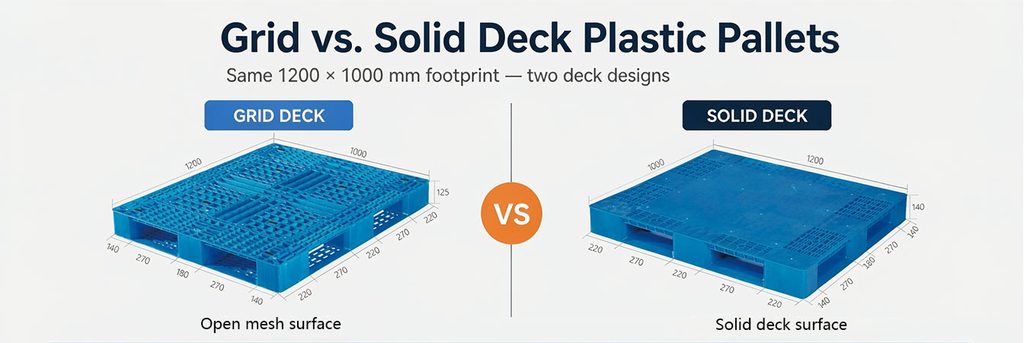
A grid deck has openings between its supporting ribs or surface sections. A solid deck provides a more continuous top surface, although particular designs may still include holes, seams, recesses or raised features. “Flat” and “solid” are not complete construction specifications.
Ask for a clear top view, underside view and relevant dimensions. The size and spacing of openings matter more than a general label. So do the edges, surface texture and any features that touch the packaging.
Brilliant’s plastic pallet buyer’s guide covers the wider selection process. Here, the focus is the interface between the deck, the package and the operating routine.
Start with cartons, bags and their contact surfaces
For cartons, inspect the bottom layer rather than only the overall load footprint. Where do carton edges and corners sit? Can a smaller carton bridge an opening without losing the support its packaging needs? Mixed-size orders may create a different contact pattern from identical cartons arranged in regular layers.
Flexible bags need a separate review. Check whether the filled bag can press into openings or catch on surface details during placement and removal. Bag material, fill behavior and closure position can change the result. A more continuous deck may be worth shortlisting, but it does not eliminate every risk of abrasion or snagging.
Rigid containers also deserve attention. Feet, narrow rims or molded bases may contact only small areas of either deck. Share photographs and underside dimensions of the actual package rather than describing the load simply as “boxed goods.”
If a liner or intermediate sheet is proposed, include it in the evaluation. It changes the contact surface and can also change airflow, cleaning work and consumable handling. Do not use a sheet as an assumed fix without checking the complete arrangement.
Compare the whole cleaning routine
A continuous top surface may offer convenient wiping access, but cleaning does not stop at the visible top. Examine seams, recesses, edges and the underside. Identify where product residue or wash water could remain and whether staff can inspect those areas.
Grid openings may provide drainage paths, while the surrounding ribs and intersections create additional surfaces to inspect. The practical outcome depends on geometry and access, not just whether the deck is open or closed.
Give the supplier your cleaning method, chemicals, process temperature and drying requirements. Ask for confirmation for the proposed material and finished configuration. Do not assume a pallet suitable for occasional rinsing is suitable for your repeated wash cycle.
Brilliant’s food, beverage and produce pallet selection page identifies flat-deck candidates while asking buyers to review drainage, cleaning chemistry and representative sanitation trials. Treat these as candidates for assessment, not automatic hygiene approval.
Check whether openings help your airflow requirement
An open deck may be useful where air needs to pass beneath or through the unit load. However, deck openings alone do not establish a cooling result. Carton construction, bag placement, liners and the arrangement of goods can obstruct the intended path.
Ask the operations team where air needs to travel and what packaging blocks that route. Evaluate the loaded pallet, not an empty deck held against the light. Where temperature control is important, use the facility’s approved validation process rather than assuming a grid pattern guarantees faster or more even cooling.
Similarly, a continuous deck is not a spill-containment system. If liquid retention is required, specify that function separately and review a purpose-designed product.
Keep top-deck choice separate from equipment fit
A suitable goods-contact surface does not establish compatibility with pallet trucks, conveyors or other handling equipment. Those interfaces depend on the complete pallet, including its base and clearances.
Keep the comparison focused: select promising top surfaces, then have the equipment team review each complete configuration. Do not replace a previously accepted pallet with a similar-looking deck and assume the underside is unchanged.
If neither candidate suits the goods, discuss the requirement before requesting a structural change. Brilliant’s manufacturing and customization overview explains the existing-product, specification-adaptation and new-development routes. Available changes depend on the selected product and production feasibility.
Use a short, representative sample review
Before a bulk order, agree on a sample review using your real packaging and approved operating procedures. Include the smallest carton, the most flexible bag or another package that makes deck contact difficult.
Record the exact pallet configuration, package layout and any liner used. Observe loading and unloading, inspect package bottoms for damage, and review cleaning access and drying under the planned routine. Set acceptance criteria with the responsible packaging, operations and quality personnel before the review begins.
The result should be a documented choice for your application, not a general declaration that one deck style is superior.
Frequently asked questions
Is a solid deck always stronger than a grid deck?
No. Deck appearance does not establish the performance of the complete pallet. Compare the identified models and their documented operating conditions rather than ranking strength by surface style.
Does a solid deck mean the pallet can contact unpackaged food?
No. Direct food contact is a separate requirement. Specify the intended contact, destination requirements and necessary documentation before selecting the material and finished product.
Can we use the same deck for cartons and bags?
Possibly, but assess both package types. Record the accepted layouts so a successful carton review is not silently treated as approval for flexible bags.
Should we change an existing pallet just to get a different deck?
First identify the problem you need to solve. If packaging damage or cleaning difficulty is the issue, compare candidate surfaces against that problem while retaining checks on the complete handling process.
Discuss your deck requirements with Brilliant
Email [email protected] with your pallet dimensions, package photographs, bottom-layer layout, cleaning routine, handling method and quantity. Explain what is not working with your current deck so the discussion starts with a practical selection need.