Static vs. Dynamic vs. Racking Load: How to Read Plastic Pallet Load Ratings
A plastic pallet’s load rating only makes sense when you know how the pallet is supported, how the goods are distributed and how it will be used. Static, dynamic and racking ratings describe different conditions. They are not interchangeable, and a high floor-supported rating does not establish a safe rack-supported capacity.
For procurement and warehouse teams, the key question is not simply, “How much weight can this pallet hold?” It is, “Can this pallet carry our unit load under the actual handling, storage and environmental conditions in our operation?”
This guide explains the three terms, the details to request from a supplier and the information needed to begin a suitable pallet recommendation.
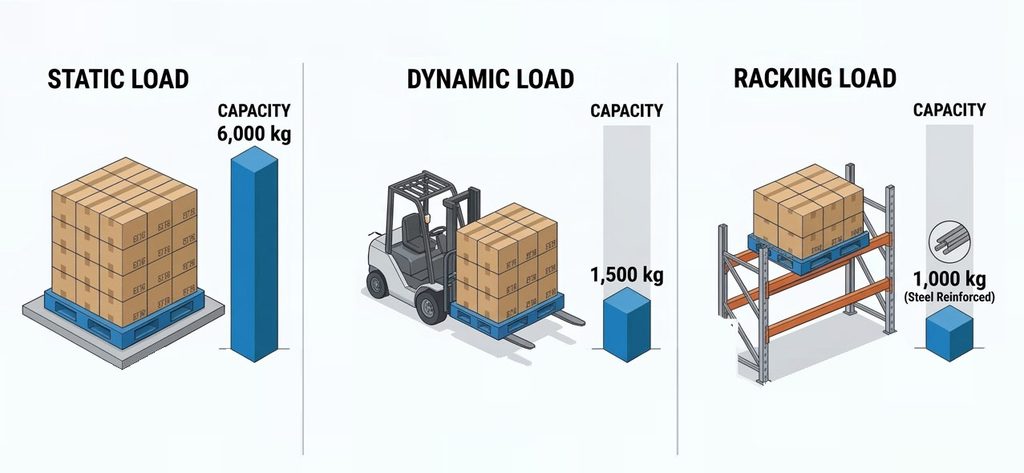
1. What Do the Three Load Ratings Mean?
| Rating | Typical operating condition | What the buyer must confirm |
| Static load | A stationary pallet supported on a specified surface, often a level, solid floor | Support conditions, load distribution, duration and whether stacking is included |
| Dynamic load | A loaded pallet being handled using specified equipment and procedures | Fork support, entry direction, load arrangement and handling conditions |
| Racking load | A loaded pallet resting on a specified rack support arrangement | Beam spacing, support direction, contact points, duration and allowable deflection |
These descriptions explain common usage. The supplier’s documented rating must identify its actual conditions. A short catalog label is not a complete operating specification.
Static load: stationary does not mean unrestricted
A static rating is commonly used for a loaded pallet resting on a level, solid floor. That support can differ substantially from the support available on forks or rack beams.
Check whether the stated value applies to a single loaded pallet or to a specified stacking arrangement. When loaded pallets are stacked, the bottom pallet, the goods, the packaging and the contact points between layers all matter. A single floor-supported rating does not establish a safe stacking height.
Dynamic load: the handling setup matters
Dynamic load generally refers to carrying a load while the pallet is handled. The applicable rating depends on the equipment and conditions described by the supplier.
Confirm fork spacing, insertion depth, entry direction and the intended forklift or pallet truck. Acceleration, braking, impacts and uneven floors can affect the operation. A dynamic rating should not be treated as permission for any driving speed, fork position or handling method.
Racking load: support is no longer continuous
In rack storage, a pallet may be supported at specific locations rather than across its base. The unsupported span, support orientation and contact details affect its behavior.
Beam-only support is not the same as a rack fitted with an approved support deck or additional bars. A rating established for one arrangement should not be transferred to another without confirmation. The pallet must also be compatible with the rack system’s requirements.
2. Why Can One Pallet Have Several Different Ratings?
The load path changes as the pallet moves through a warehouse,
- On a solid floor, more of the pallet base may be supported.
- On forks, support is concentrated in the fork contact areas.
- On a rack, the pallet may bridge between supports and experience sustained bending.
That is why a single model can have different documented ratings under different conditions. It is also why there is no universal conversion from static to dynamic or racking capacity. Do not divide a static rating by a fixed number to estimate a rack rating.
A buyer should request separate confirmation for every important stage in the route: receiving, forklift handling, floor storage, rack storage and any conveyor or automated movement. A pallet suitable at one stage is not automatically suitable throughout the entire system.
3. Check Load Distribution Before Comparing Capacity Numbers
Two unit loads can weigh the same but load a pallet very differently.
Cartons spread across the deck may produce a different stress pattern from drums, machine feet, a compact central load or an item that overhangs the pallet. A flexible package and a rigid container may also transfer weight differently.
Do not assume a rating based on distributed loading also covers point loads. Ask what distribution was used to establish the published value and whether it reasonably represents your goods.
Also clarify whether a quoted capacity means the payload alone or another defined loading quantity. Keep pallet tare weight separate from the goods weight so the supplier and the equipment operator are discussing the same numbers.
4. Specify the Rack Arrangement, Not Just “Rackable”
“Rackable” is a starting description, not a complete approval for every warehouse rack.
Record the beam spacing and explain how the pallet will sit on the supports. Include a drawing that identifies which edges or runners make contact. If the rack uses support bars, decking or a specialized storage mechanism, show those details as well.
Ask about the criteria used to assess deformation. A pallet may need to remain within limits for safe clearance, equipment operation or the handling of the goods, not merely avoid immediate breakage.
Provide the planned storage duration. Plastics can show time-dependent deformation under sustained loading, and temperature may affect that behavior. A short-duration observation is not automatically evidence for long-term rack storage.
For automated systems, dimensional consistency and the interaction with conveyors, sensors, guides and lifting devices also need review. A structural load rating alone does not establish equipment compatibility.
5. Keep Material and Configuration Attached to the Rating
A rating should refer to an identifiable pallet configuration.
Material type, formulation, manufacturing consistency, geometry and any reinforcement can influence performance. A rating for one version should not automatically be copied to another version that uses a different material grade or configuration.
When comparing HDPE and PP, or virgin, modified and recycled material options, avoid assuming that the material name alone determines the operating capacity. Request documentation for the proposed finished pallet.
Similarly, added reinforcement does not create an unlimited capacity or make every rack arrangement acceptable. Confirm the reinforcement layout, the supported orientation and the conditions for which the complete pallet was assessed.
Browse Brilliant’s heavy-duty plastic pallet range as a product starting point, then ask for confirmation of the specific configuration for your use.
6. Ask What the Test or Assessment Actually Covers
A useful load report connects a clear result to a clear test setup.
Ask for the pallet model, dimensions, material specification, reinforcement details, sample identification and test date. The document should also explain the support arrangement, loading pattern, duration and relevant acceptance criteria.
Where a test standard is referenced, check the exact standard, version, methods used and scope of the reported result. A reference to a standard is not the same as certification, and a general test-method result is not automatically an allowable payload for every real unit load.
Distinguish between a test load, a measured failure result and the operating load recommended for your application. The relationship between them needs an appropriate assessment. Do not apply a blanket safety factor to every model, test or handling situation.
If a certificate or laboratory report is supplied, verify that it applies to the proposed product and configuration. Ask for missing conditions to be clarified in writing rather than interpreting a catalog number as a complete engineering statement.
7. Review the Complete Handling Route
A pallet can pass through several support conditions during one trip. Map that route before approving a purchase.
For example, goods may first sit on a warehouse floor, move on a forklift, enter rack storage and later travel on a conveyor. Each stage may introduce different requirements. Environmental conditions and the length of storage can change along the route as well.
Discuss the proposed model with the relevant warehouse, equipment and safety personnel. Where practical, agree on an application trial using representative goods and approved procedures before committing to a wider deployment. A trial supplements the documented assessment; it should not involve deliberately exceeding approved conditions.
Inspection and damage criteria should be part of the operating plan. A rating does not mean a cracked, deformed or otherwise damaged pallet should remain in service. Ask for suitable inspection guidance and establish who decides when a pallet is removed from use.
8. Common Mistakes to Avoid
Using static capacity as rack capacity. Floor-supported and beam-supported conditions are different. Request the rack assessment.
Comparing two numbers without comparing their conditions. A larger published value may describe a different load distribution, support arrangement or storage duration.
Treating runners as proof of rack suitability. The presence of runners does not establish compatibility with every rack, orientation or span.
Ignoring the load footprint. Concentrated loads and overhang need attention even when total weight is below a catalog figure.
Applying one rating to every material option. Confirm the finished model and material configuration being offered.
Assuming a test reference proves every application. Read the report scope and agree on the operating conditions in writing.
9. What to Send When Requesting a Pallet Recommendation
A practical request should include the following information:
| Information | Why it helps |
| Goods weight and package arrangement | Identifies the payload and load distribution |
| Required pallet footprint | Helps assess goods fit and equipment clearances |
| Handling equipment and entry direction | Establishes the relevant fork or other support conditions |
| Rack drawing, support spacing and orientation | Allows review of the actual rack-supported arrangement |
| Floor storage and stacking details | Separates single-pallet support from stacked-load requirements |
| Storage duration and operating temperature | Identifies sustained-load and environmental conditions |
| Conveyor or automated system details | Supports a separate compatibility review |
| Proposed material and reinforcement options | Keeps the rating tied to the offered configuration |
Photographs and layout drawings can be more informative than a request for “a pallet that carries several tons.” If a requirement is not yet known, mark it as an open question. Do not substitute a guessed value simply to complete the form.
Request a Recommendation Based on Your Actual Conditions
Brilliant supplies plastic pallets for different handling and storage needs. Use the plastic pallet product catalog to identify possible options, then discuss the exact application before choosing a configuration.
Request a Pallet Recommendation for Your Load Conditions: Send your goods weight, load arrangement, handling method and rack details to [email protected].
Frequently Asked Questions
Can I calculate racking capacity from a static rating?
No universal conversion is appropriate. Rack capacity depends on the pallet configuration, load distribution, support arrangement, duration and other conditions. Request a documented assessment for the proposed use.
Does a higher dynamic rating mean a pallet is better for racking?
Not necessarily. Dynamic handling and rack storage impose different support conditions. Compare a suitable rack assessment rather than using a dynamic figure as a proxy.
Is the rated capacity per pallet or per shelf or layer of goods?
Check the supplier’s definition. Pallet ratings normally refer to specified loading of the pallet, but they do not automatically establish safe stacking height, product stacking strength or rack capacity. Clarify exactly which load and arrangement the stated value covers.
Do I need a separate review for cold storage?
Provide the actual temperature, handling conditions and storage duration. Material behavior and impact conditions can change with the environment. Do not assume a room-temperature rating covers the proposed cold-storage use.
Does passing a load test mean the pallet is certified for my warehouse?
Not by itself. Review the test scope, the offered configuration and your actual application. Equipment compatibility, operating procedures and applicable safety responsibilities still need to be addressed.