Rackable Plastic Pallets: What to Check Before You Buy
Buying rackable plastic pallets starts with a warehouse question, not a catalog label: how will this pallet sit in your rack? A familiar footprint or a heavy-duty description can help create a shortlist, but neither establishes that the pallet fits your support arrangement and handling route.
The useful next step is to turn your rack layout into a buying brief. With the right drawings, load details and equipment information, procurement teams can compare proposals on the same basis and identify what needs confirmation before ordering.
For broader selection decisions, start with our plastic pallet buyer’s guide. Here, the focus is the rack interface: support geometry, pallet orientation, bottom structure and application approval.
Start with the support beneath the pallet
Describe what actually supports the loaded pallet. Front and rear beams, side rails, support bars and decking create different contact arrangements. A rack name alone may not reveal those details, especially where a warehouse has several storage systems or modified bays.
Ask the warehouse team for a current drawing and photographs of the intended positions. Identify the bearing surfaces, any intermediate supports and where the pallet base will make contact. If decking or bars are present, record them rather than assuming the pallet will always receive continuous support.
Keep rackable and stackable separate. Stackable describes a different storage arrangement; it does not establish suitability for a pallet bridging rack supports. Likewise, a pallet listed for warehouse use may serve floor storage or circulation without being suitable for your rack.
Brilliant’s warehouse rack pallet page is a starting point for comparing structures, not blanket approval of every listed option for every rack.

Make orientation and unsupported span visible
Two drawings can show the same pallet footprint but different support conditions if the pallet is rotated. Mark the loading direction, the pallet’s long and short sides, and which parts of its base rest on the beams or rails.
Record the clear unsupported span separately from any beam center-to-center dimension. Include the bearing width and support positions so the supplier can interpret the measurements correctly. Where information is missing, ask the rack provider or responsible site personnel to verify it; do not fill gaps with a typical warehouse dimension.
For example, a proposal assessed with runners oriented one way should not silently become an approval for placing the pallet the other way. Ask the supplier to return an annotated support sketch with the proposed configuration. This gives purchasing and warehouse teams a shared reference without asking either team to infer the load path from a product photograph.
These checks gather application information. Changes to rack supports or pallet placement need approval from the responsible rack or engineering personnel, not an improvised adjustment during delivery.
Check the underside against the whole handling route
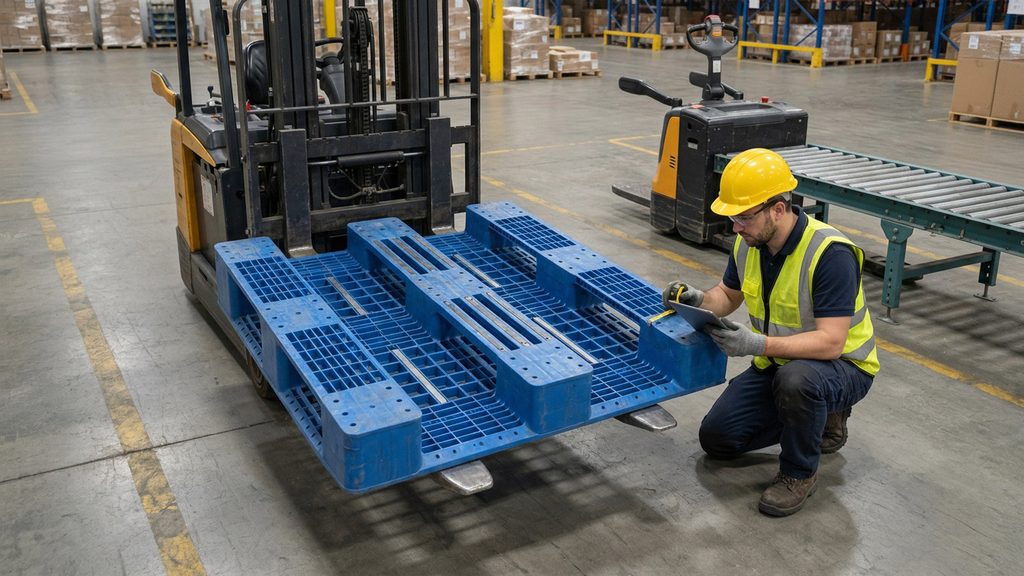
Review the bottom structure as carefully as the top deck. Runner positions, openings and contact surfaces determine where equipment can engage the pallet and where support is available. Three runners, a perimeter base or steel reinforcement may be relevant design features, but none automatically makes a pallet rack-safe.
Request a dimensioned base drawing for the offered configuration. Match it to forklift entry direction, fork dimensions and insertion requirements. For pallet trucks, confirm that the fork and load-wheel movement can work with the base openings and floor contact areas. Forklift access alone does not prove pallet-truck compatibility.
If conveyors are involved, share the roller or chain arrangement, transfer points and guide clearances with the supplier and equipment provider. Contact across a conveyor can differ from contact on rack beams. Confirm the selected model for that equipment rather than accepting “conveyor compatible” as an unrestricted statement.
Compare an identified configuration, not a headline capacity
Ask each supplier to identify the pallet, material specification, base structure and any reinforcement included in the quotation. Keep those details attached to the rack assessment. A change in material or reinforcement layout needs review rather than being treated as an equivalent substitution.
Our guide to plastic pallet load ratings explains the capacity terminology. For this purchase, the practical question is whether the documented rack conditions represent your actual use.
Provide the goods layout as well as the weight. Concentrated contact points, gaps and overhang can make a proposal based on distributed cartons a poor match. Include expected loaded storage duration and the actual operating temperature range. Sustained loading and environmental conditions belong in the assessment, not in a generic capacity comparison.
A heavy-duty classification is useful for narrowing the search, but it is not a substitute for this application match.
Put the missing information into the RFQ
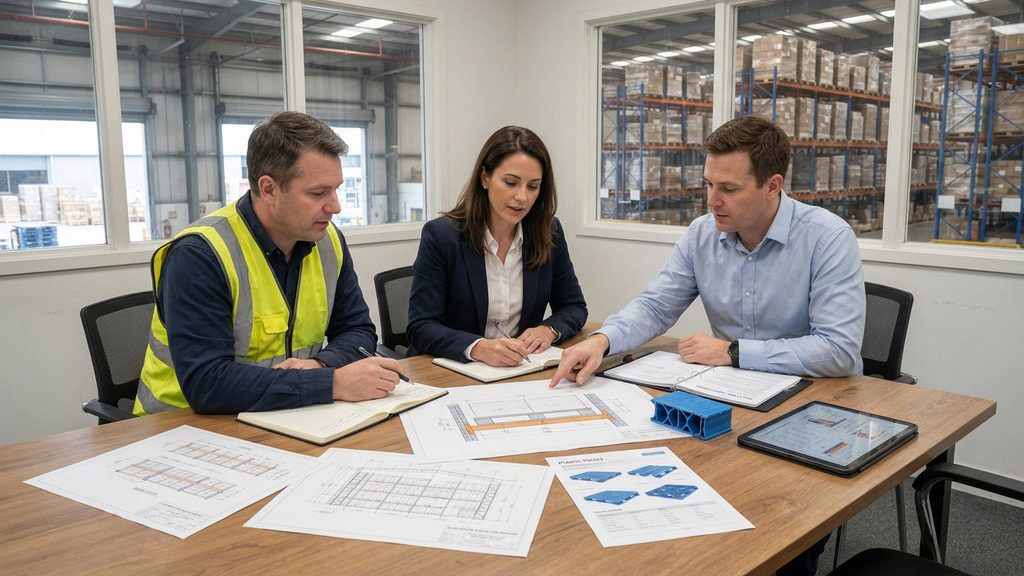
A concise information pack reduces repeated questions and makes competing offers easier to review. Use the following table as a procurement handover between the warehouse, supplier and equipment teams.
| Information to send | Confirmation to request |
| Rack drawing and support photographs | The support arrangement used for the proposed pallet assessment |
| Clear span, bearing widths and support positions | Measurements and contact locations interpreted consistently |
| Pallet footprint and placement orientation | An annotated drawing showing the approved orientation |
| Goods weight, footprint and contact pattern | Assessment based on representative loading |
| Base drawing and handling equipment details | Entry, wheel clearance and conveyor contact checked by equipment |
| Loaded storage duration and operating environment | Conditions covered by the supporting assessment |
| Material, reinforcement, quantity and delivery needs | A clearly identified configuration and comparable quotation scope |
Mark unresolved items as open questions and assign someone to obtain them. A complete-looking RFQ built on guessed measurements is less useful than an honest brief with a few clearly identified gaps.
Agree on evidence and acceptance before the bulk order
Ask what documentation supports the proposed use and whether it covers the offered configuration and support sketch. Where application testing is needed, agree on representative goods, support conditions, duration and acceptance criteria before arranging samples. Availability, scope and cost should be confirmed rather than assumed.
Involve the responsible site, rack and equipment personnel in approving any trial procedure. Check placement, retrieval, clearances and handling as well as deformation under the agreed conditions. Do not use a warehouse trial to explore unknown limits or exceed approved conditions.
Carry the accepted configuration, drawings and relevant inspection requirements into the purchase order. This helps prevent an apparently minor substitution from changing what was reviewed. Brilliant’s manufacturing and customization overview explains how existing specifications and project-specific changes can be reviewed, subject to feasibility.
Frequently asked questions
What if our warehouse uses several rack layouts?
Create a separate application sheet for each layout and identify where each approved pallet configuration may be used. If you want one common pallet, ask for confirmation across all intended layouts rather than selecting only the easiest case.
Can we request a quote before every measurement is available?
Yes, but distinguish an initial commercial discussion from a confirmed technical selection. List the missing information and ask which items must be resolved before a configuration and order can be finalized.
What should trigger a review after the first order?
Changes to the goods, rack arrangement, handling equipment or operating conditions should prompt a review. Keep the original application record available so repeat purchasing does not rely solely on the previous product description.
Discuss your rack application with Brilliant Pallet
Send your rack drawing, goods layout, handling details and quantity plan to [email protected], or use the warehouse pallet RFQ form. Start with the actual application so the proposed pallet and any outstanding checks are clear before you buy.